
Financial Services
Insight Custodia — FATCA, CRS & AML/CFT Compliance for Fund & Investor Services
Insight Custodia is a single, auditable system for FATCA, CRS and AML/CFT compliance — investor onboarding, U.S. indicia detection, regulatory XML reporting, and financial-crime case management, built for fund administrators, trust companies and corporate services providers.
The day-to-day journey
From onboarding to filed report
Guided, self-service onboarding
New investors, beneficiaries and shareholders are asked a short series of plain-language questions about their circumstances, and the system recommends exactly which form they need — W-9, W-8BEN, W-8BEN-E, or CRS self-certification. They complete it and upload supporting documents directly, no PDF-by-email required.
Automatic detection of U.S. indicia
Every submission is automatically checked for clues that someone might be a U.S. taxpayer despite what their paperwork says — a U.S. place of birth, address, phone number, or standing payment instructions. Anything found gets flagged for review rather than passing through silently.
Reviewed by the right level of authority
Flagged cases land on a dedicated queue. Compliance analysts can clear a flag with satisfactory documentation; escalating a case to 'recalcitrant' status is reserved for more senior compliance staff — the same separation of duties a well-run compliance function expects.
Nothing lapses unnoticed
Self-certifications only stay valid for a limited period. The system tracks every form's validity on a rolling basis and surfaces upcoming expiries, and it supports change-in-circumstances monitoring if new information contradicts what's on file.
Filings compiled, validated, and packaged
The reporting engine compiles structured filings for tax authorities automatically, checks them for completeness and internal consistency, and validates them against the technical formatting rules authorities require — removing the biggest source of manual error in a spreadsheet-based process.
Inside the platform
Tax compliance and financial crime, one system
Jump straight to a module to see how it works, with real screenshots from a live system.
Compliance Dashboard
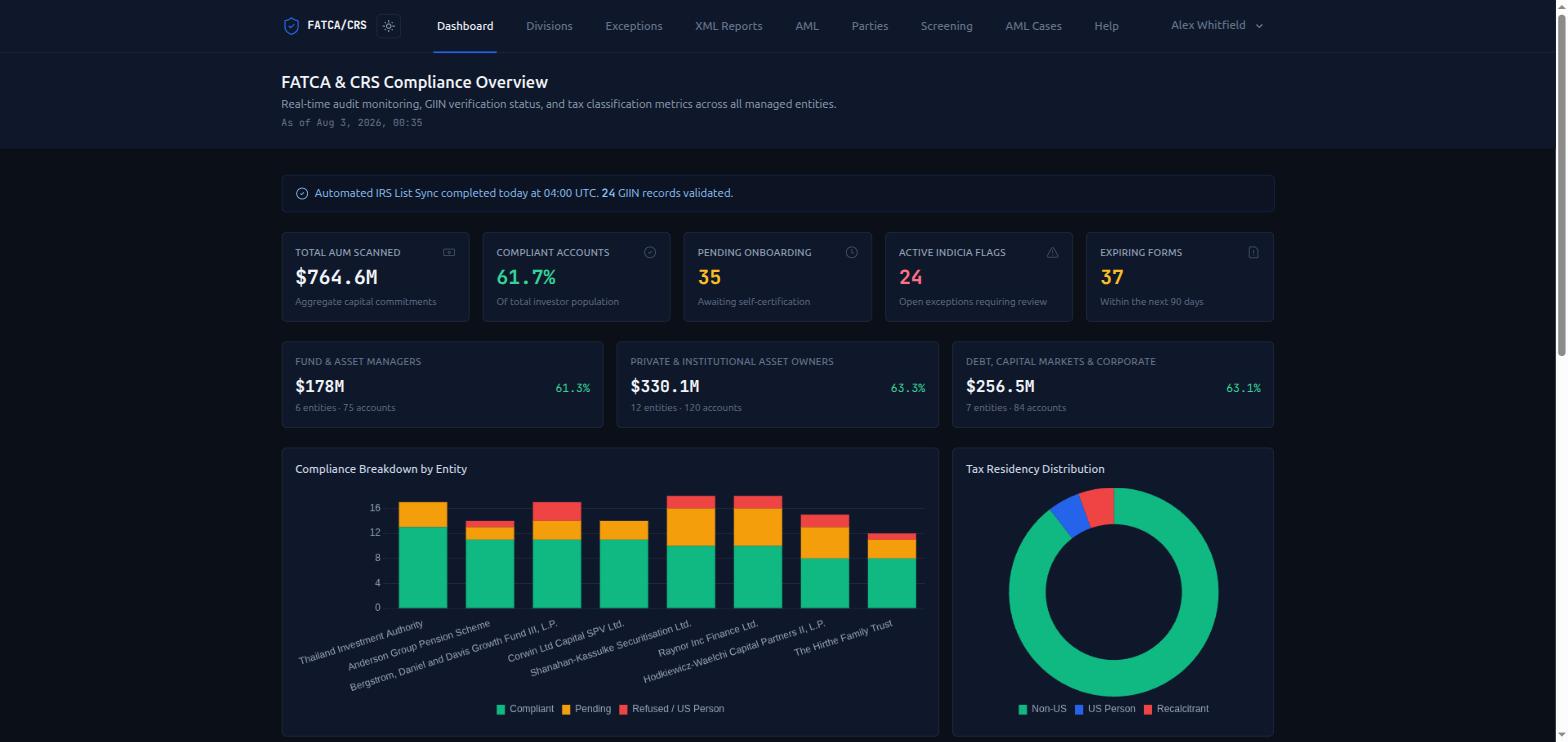
A live view of the business's FATCA/CRS position the moment a Super Admin logs in — AUM scanned, compliant-account rate, open indicia flags, and expiring forms, broken down by division.
- Real-time compliant-account percentage
- Open indicia flags & expiring forms at a glance
- Compliance breakdown by entity
- Tax residency distribution across the portfolio
Divisions & Entities
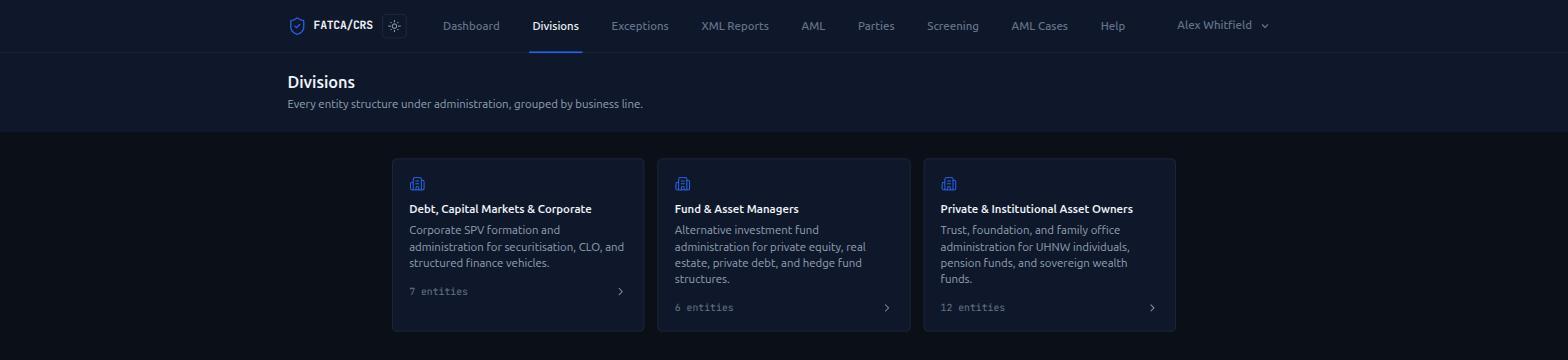
Fund & Asset Management, Private Wealth & Institutional, and Debt/Capital Markets/Corporate — three distinct client bases, all sharing the same compliance engine.
- Live entity count per division
- Every entity classified by structure, jurisdiction & regulatory regime
- One shared compliance record — no re-entry between divisions
- Model 1 / Model 2 / Non-IGA classification applied automatically
GIIN & Responsible Officer Certification
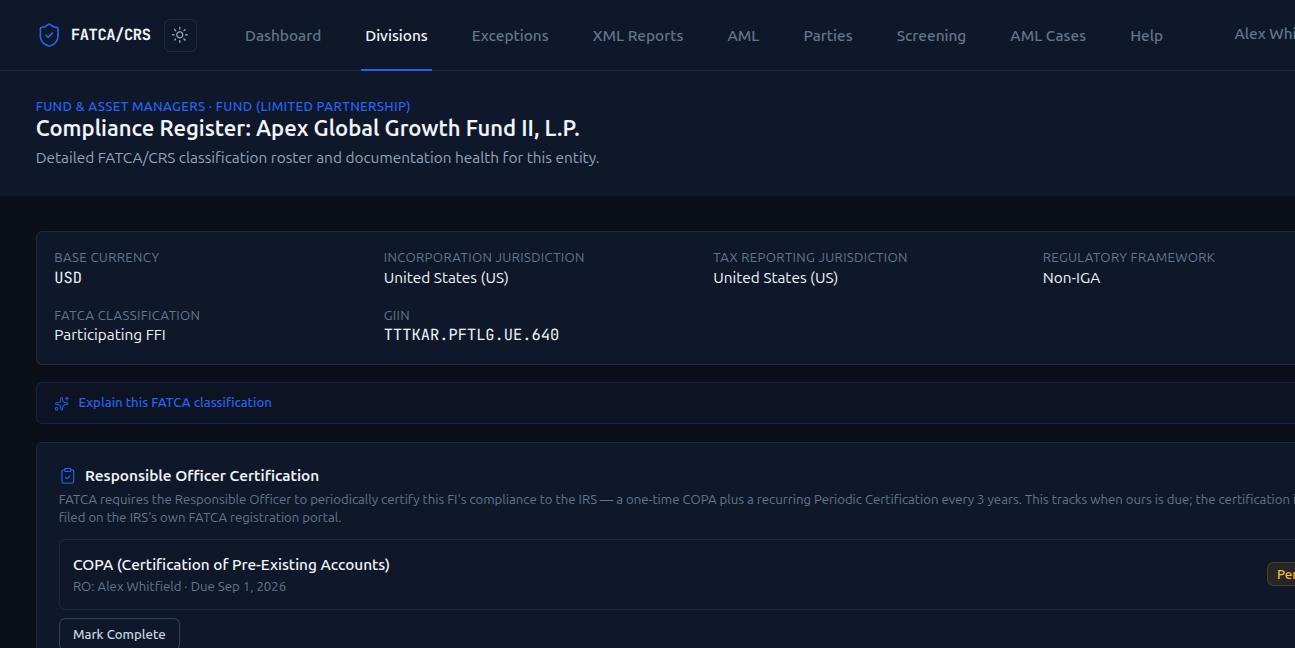
Investor reporting isn't the only clock running on an entity. Each FFI's own Global Intermediary Identification Number (GIIN) sits on its compliance register alongside its Responsible Officer (RO) certification obligation — a one-time Certification of Pre-existing Accounts (COPA) plus a recurring filing every three years — tracked against a named RO and a real due date.
- GIIN recorded directly against the entity
- COPA + recurring 3-year Periodic Certification tracked separately
- Named Responsible Officer and due date, not just a checkbox
- A lapsed certification risks the entity's FFI status itself — flagged well before the deadline
Investor Self-Service Onboarding
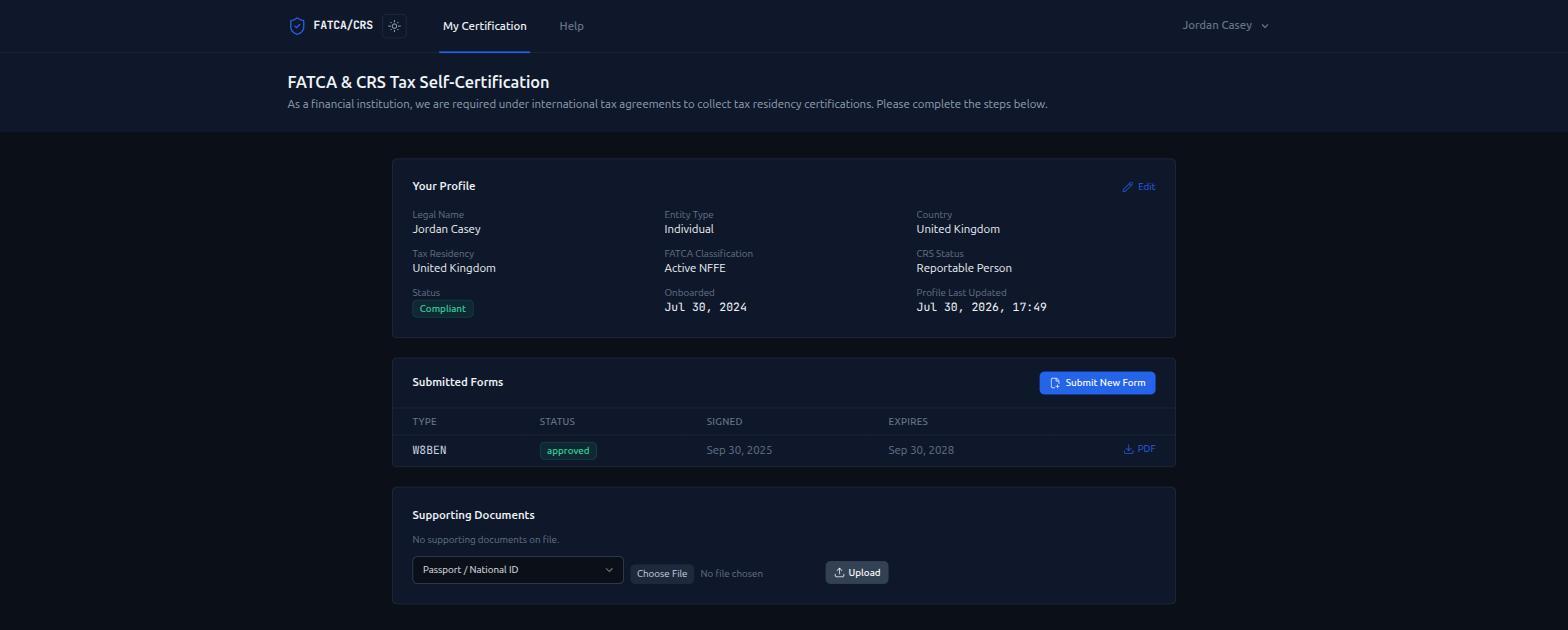
Investors complete their own FATCA/CRS profile, submit the right form, and upload supporting documents from a self-service portal — no chasing paper forms by email.
- Plain-language guided questions recommend the right form
- W-9, W-8BEN, W-8BEN-E & CRS self-certification supported
- Document upload attached directly to the investor profile
- Everything time-stamped and ready for review
Multi-Jurisdiction Tax Residency
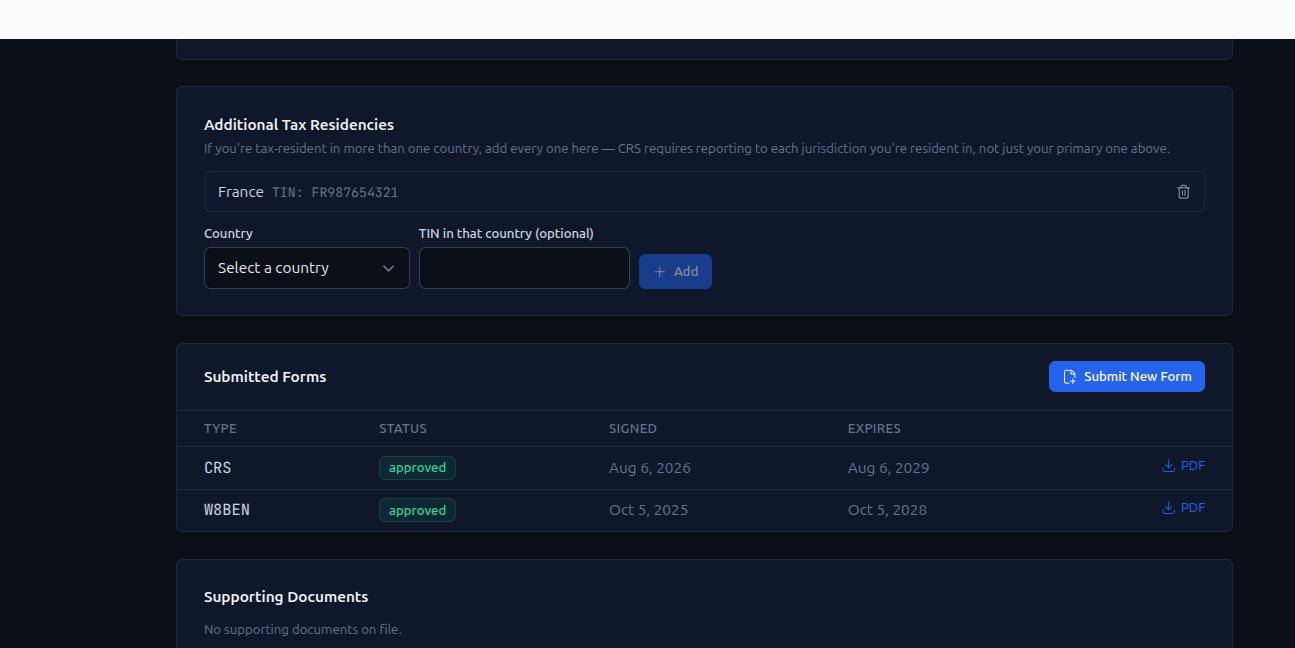
CRS doesn't stop at one home country. An investor tax-resident in more than one CRS-participating jurisdiction has to be reported to every one of them — a dual resident missed at onboarding is a real, recurring source of under-reporting. Investors can add every additional tax residency themselves, with its own TIN, from their own self-certification screen.
- Every additional tax residency captured, not just the primary one
- Its own TIN per jurisdiction, where one applies
- Self-service — the investor adds it, not a case worker chasing a spreadsheet
- Closes a genuine, recurring under-reporting gap
Indicia & Exception Desk
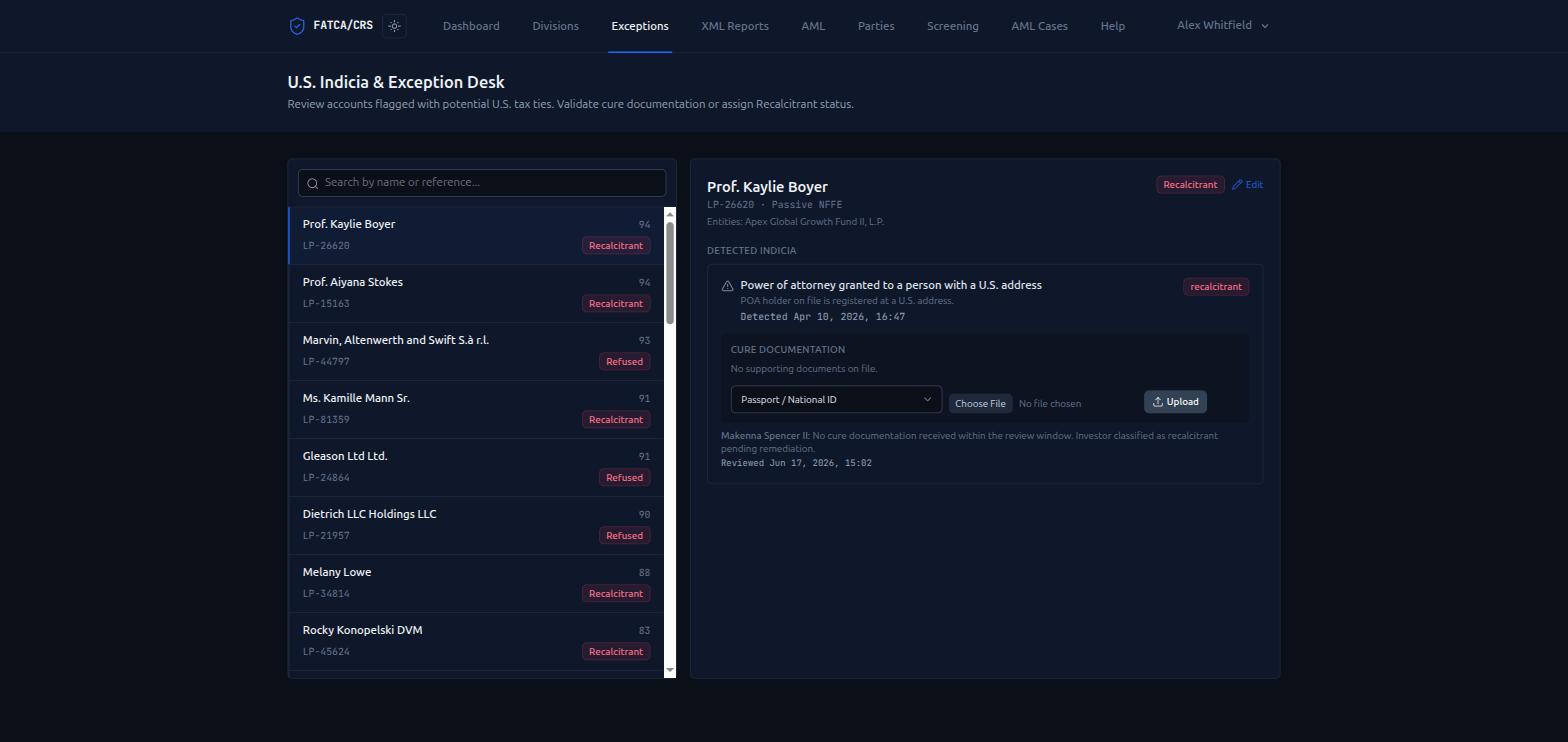
A dedicated review queue for anything the system flags — with the detected indicia, supporting documents, and a clear cure-documentation workflow for reviewers.
- Automatic U.S. indicia detection on every submission
- Clear a flag with documented evidence, or escalate it
- 'Recalcitrant' escalation reserved for senior compliance staff
- Full audit trail of who made which judgement call
Per-Tax-Year Account Valuations
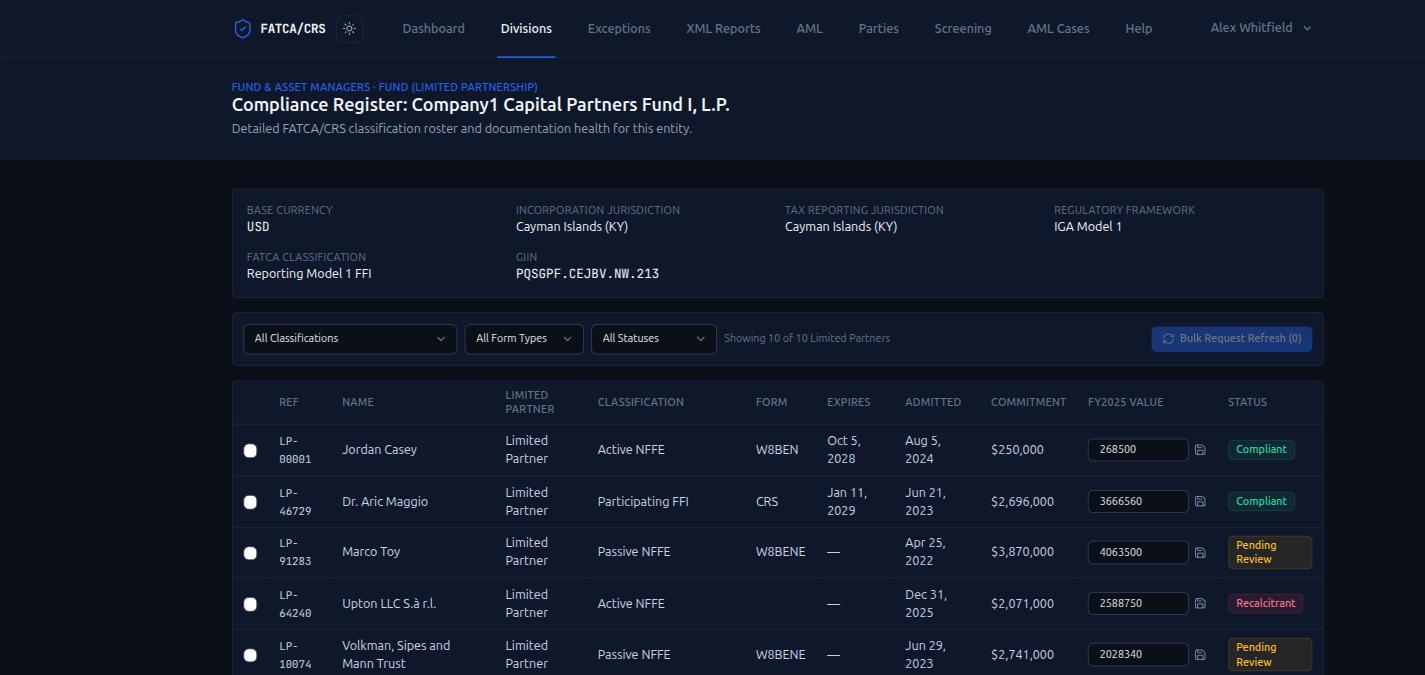
Every reportable account's balance or value is recorded separately for the specific tax year being reported, drawn from the fund's own periodic valuation statements — never confused with an investor's original capital commitment, a one-time figure that has nothing to do with what an account is actually worth at year-end.
- Tax-year balance kept distinct from original capital commitment
- Sourced directly from the fund's own valuation statements
- Reports flag any reportable account missing a valuation for the year
- Removes the single most common cause of an incorrect filing
Regulatory XML Reporting
Select an entity, validate its data, and compile a filing-ready submission for the IRS or a CRS authority — checked for completeness before it ever leaves the building.
- Automatic compilation from live compliance data
- Formatting & completeness validation before submission
- Correct jurisdiction rules applied automatically
- Cuts the single biggest source of rejected filings

AML/CFT Dashboard
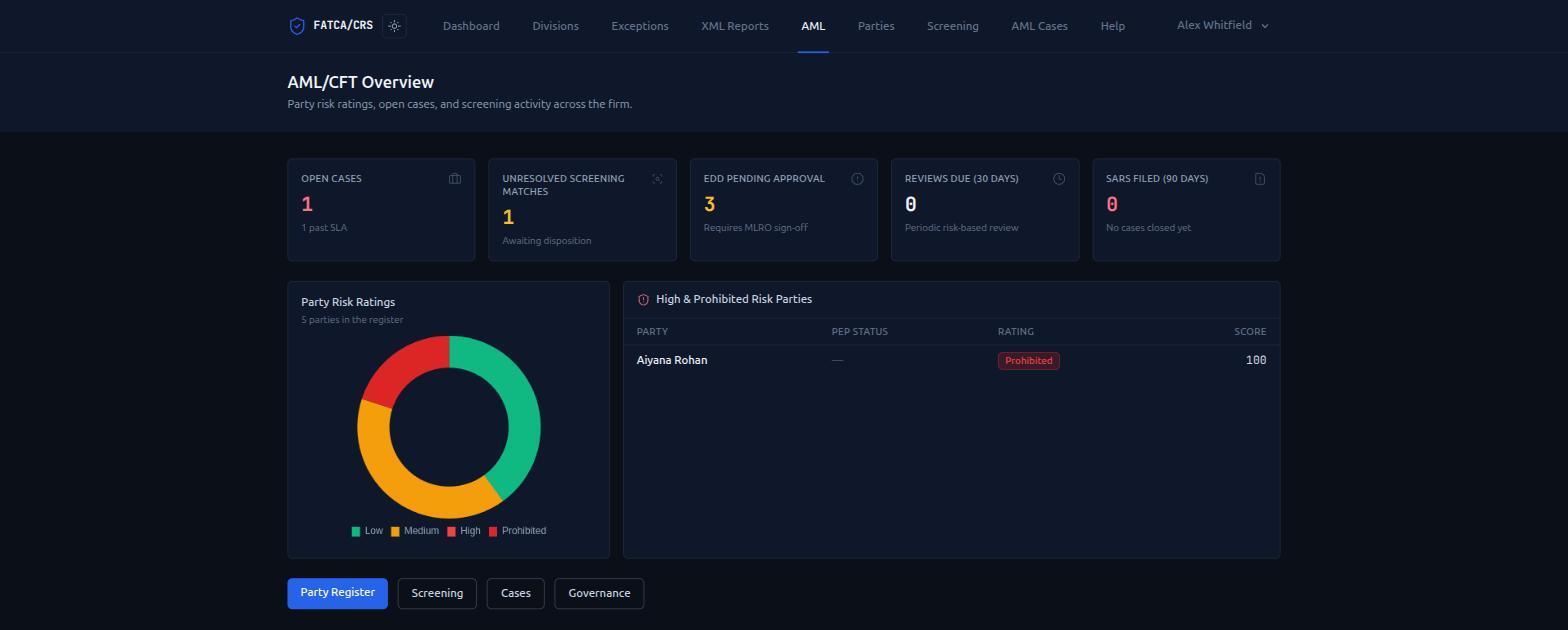
Tax compliance answers 'is this person reportable?' — AML answers 'is this relationship a financial-crime risk?' Both run from the same client records, on the same platform.
- Open cases & unresolved screening matches at a glance
- Enhanced Due Diligence (EDD) pending approval, tracked to sign-off
- Party risk-rating breakdown across the book
- Built on the same records as tax compliance — no duplicate entry
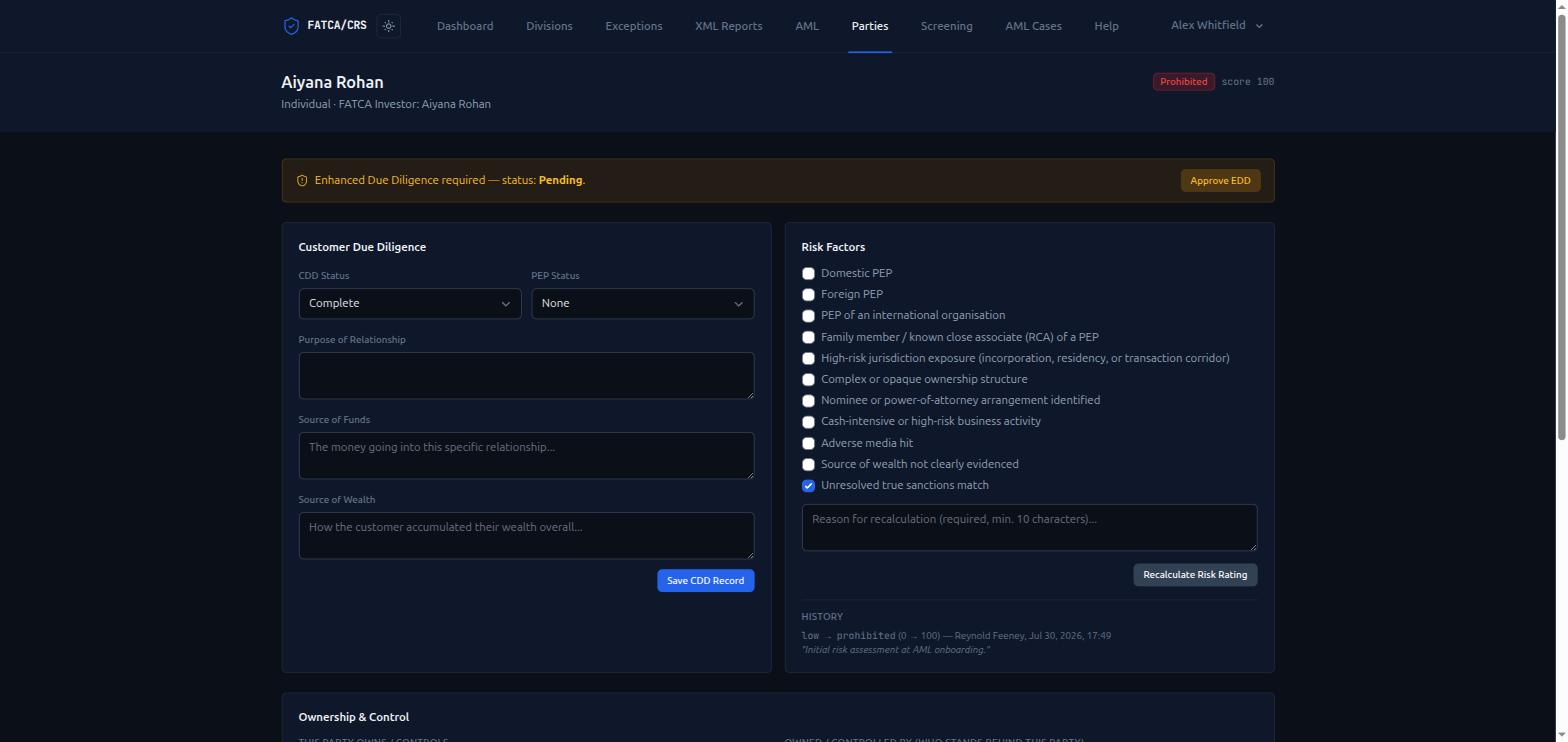
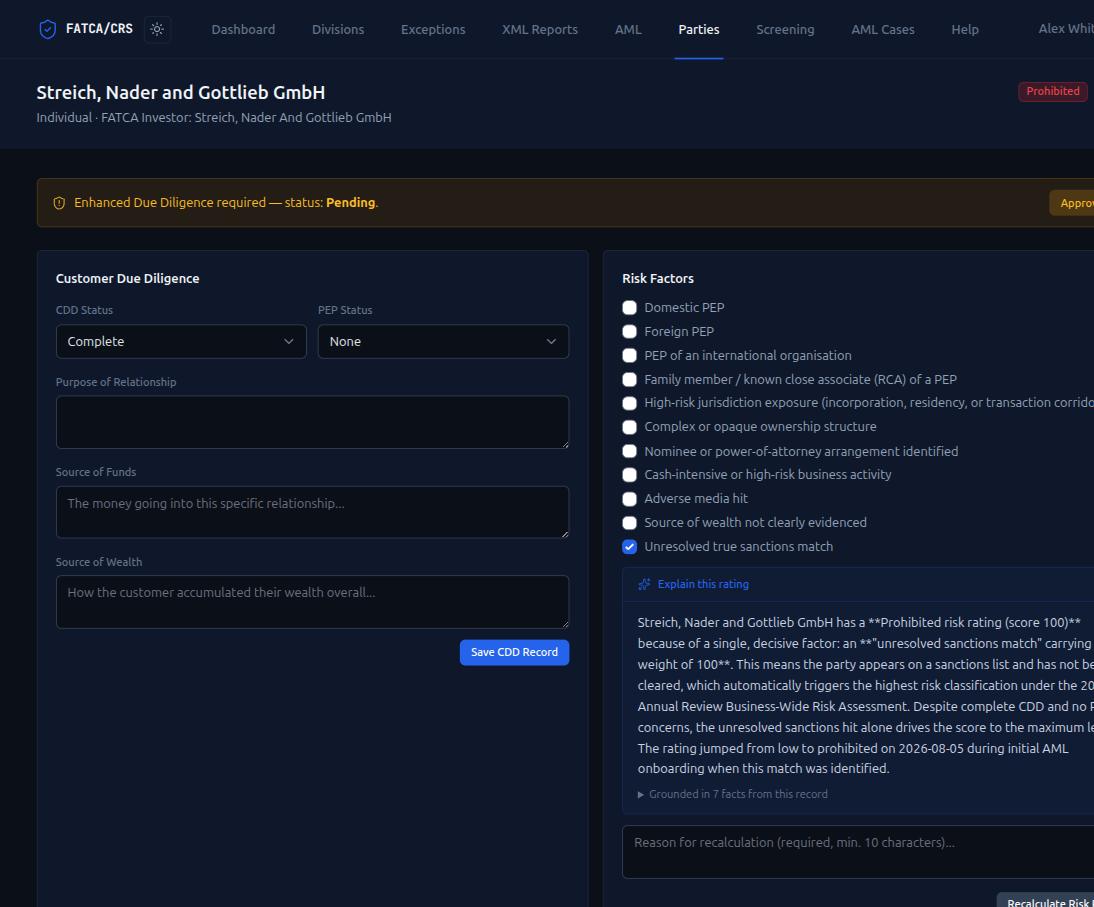
Party Risk & Due Diligence
Every individual or entity gets a due diligence record — identity, source of funds, source of wealth — plus a documented, weighted risk rating and a full ownership map tracing who really stands behind a structure. Ownership itself is policed automatically: any stake at or above the standard 25% beneficial-ownership threshold — shareholder, Ultimate Beneficial Owner (UBO), general or limited partner — flags the structure as complex and requires Enhanced Due Diligence before it can be signed off, rather than waiting for a reviewer to notice.
- Low / Medium / High / Prohibited risk rating, weighted & documented
- Ultimate beneficial ownership mapped in both directions
- Any ownership stake ≥25% automatically forces Enhanced Due Diligence — never left for staff to catch manually
- Every rating change logged — who, when, and why
Sanctions & PEP Screening
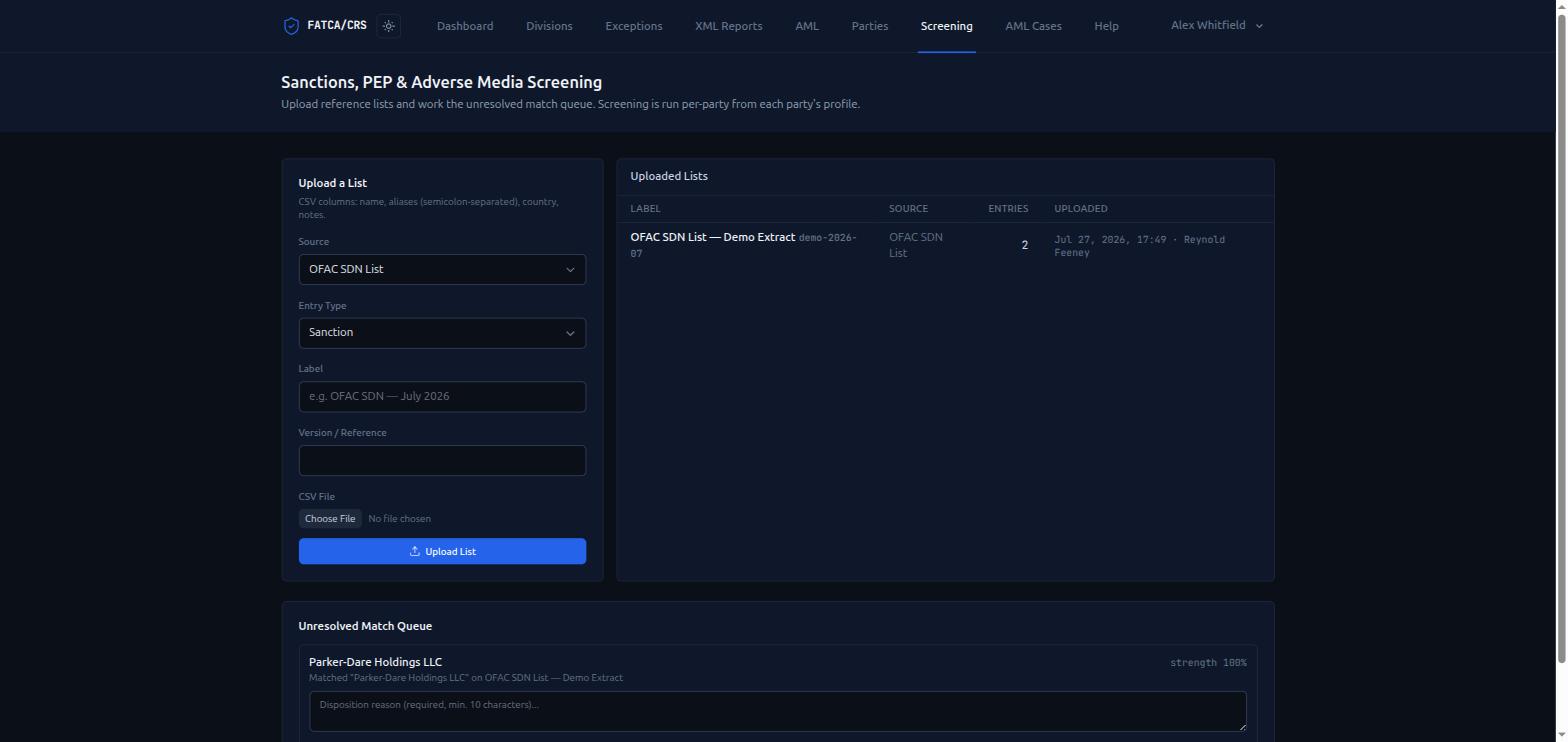
Upload sanctions, Politically Exposed Person (PEP) and adverse-media reference lists and screen any party against them at any time, with fuzzy name matching that catches transliterated variants.
- Fuzzy matching, not exact-spelling only
- Every match scored and requiring a documented disposition
- False positives dismissed with a documented reason
- Escalated matches open a case automatically
Business-Wide Risk Assessment
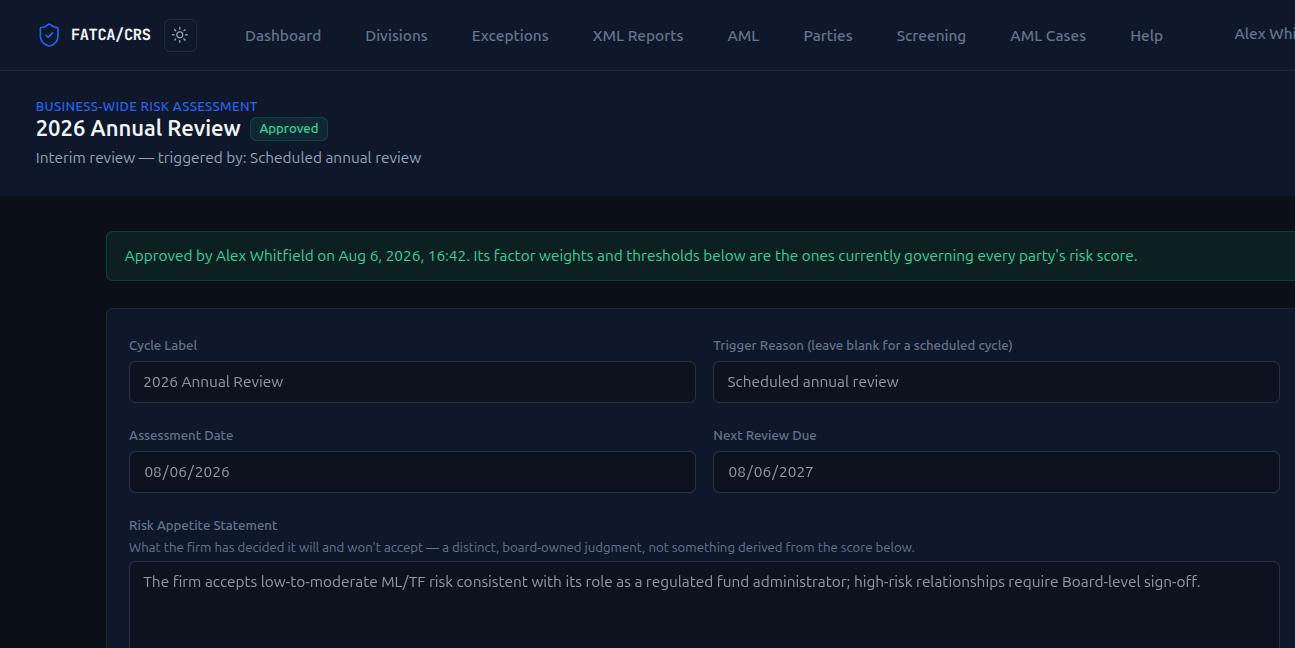
The firm's own board-level judgement on where its money-laundering risk sits — scored across six categories, each judged for inherent risk before controls and residual risk after them. Change a weighting in this year's approved assessment, and every party's individual risk rating recalculates against it immediately.
- Six risk categories, each scored inherent vs. residual
- A separate, board-owned risk appetite statement, distinct from the calculated score
- A live evidence snapshot pulled from the firm's own data, not written from memory
- A jurisdiction risk register flags book-of-business countries with no rating on file
Investigations & SAR Filing
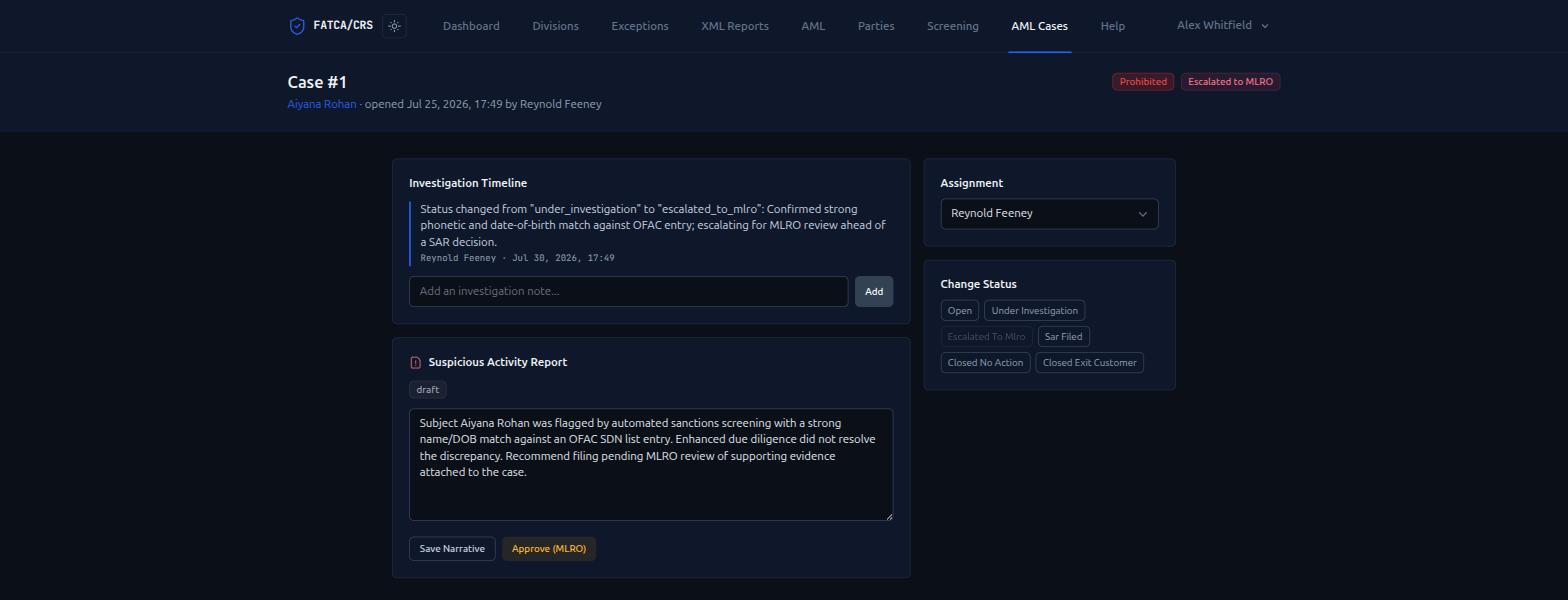
An escalated match opens a formal investigation — open, under investigation, escalated to the senior AML officer, closed — with a full timestamped log, and where necessary, a Suspicious Activity Report (SAR) awaiting approval from the firm's Money Laundering Reporting Officer (MLRO).
- Full investigation timeline & assignment tracking
- Draft SAR/STR prepared for MLRO approval before filing
- 'No tipping off' is a hard boundary, not a setting
- Never visible to the client or investor themselves
AI Assistance — Grounded, Optional, and Governed
An 'Explain this' panel gives a plain-English explanation of a risk rating or FATCA classification — grounded entirely in the specific facts already on file for that record, with a 'grounded in N facts' list a reviewer can expand and check. A separate AI Suggested Tasks toggle turns a passive warning into an owned job: when the risk assessment spots a book-of-business jurisdiction with no rating on file, an MLRO can Accept it — which assigns the gap with a real due date — or Dismiss it with a documented reason the system then respects, so a dismissed gap is never silently re-raised. Neither toggle ever sets a rating or takes an action on its own, and the firm can switch either off entirely without losing any underlying compliance logic.
- Every answer traceable back to the exact facts that produced it
- Reads only — never changes a rating, classification, or flag itself
- Risk-register gaps become an owned, deadline-bound task — Accept or Dismiss with reason
- Two independent Super Admin switches, off by default, enforced server-side
Talk to us about your compliance obligations
Fund administrators, trust companies and corporate services providers — see how this maps onto your own divisions and workflows.
Get in touch